lunes, 14 de marzo de 2022


ENGLISH:

Homework:

- Review Present Perfect:

PRESENT PERFECT

This verb tense helps us to express:

- An action or situation that began in the past and continues in the present

I have lived in Bristol since 1984 (I still live there.)

- An action that has been completed in the very recent past, indicated by 'just'.

 I have just finished my work.

- An action for which the precise moment in which it happened is not important.

 I have read 'El Quijote'. (what is relevant what I did and not when)

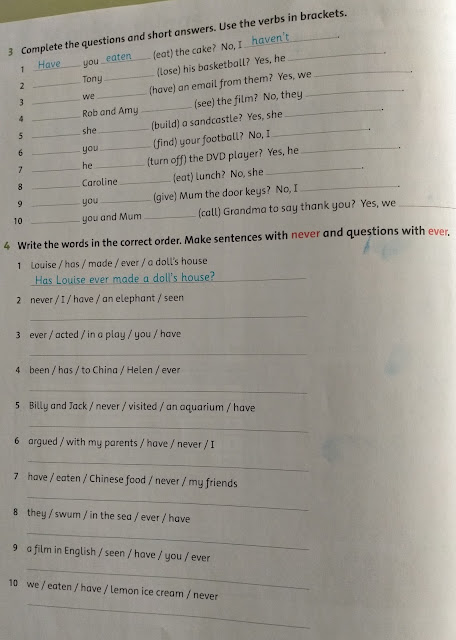
Present perfect with "ever" and "never":

EVER is used in questions before the past participle verb:

Have you EVER been in New York?

Has your cousin EVER eaten shushi?


NEVER is used also used before the past participle verb in negative sentences. It means "nunca":

I´ve NEVER been in Berlin.

She has NEVER driven a car. 


 Present perfect with "since" and "for":


- Videos to review: 

Present perfect: 

Differences between Past simple and Present perfect:


- Games to practice Present Perfect:

PAST PARTICIPLE VERBS GAME (USEFUL FOR PRESENT PERFECT)

PRESENT PERFECT POSITIVE

PRESENT PERFECT NEGATIVE

PRESENT PERFECT QUESTION

PRESENT PERFECT (VARIED)

PRESENT PERFECT (VARIED)


ENJOY A LOT THIS WEEKEND!


viernes, 11 de marzo de 2022


ENGLISH: 

PRESENT PERFECT

This verb tense helps us to express:

- An action or situation that began in the past and continues in the present

I have lived in Bristol since 1984 (I still live there.)

- An action that has been completed in the very recent past, indicated by 'just'.

 I have just finished my work.

- An action for which the precise moment in which it happened is not important.

 I have read 'El Quijote'. (what is relevant what I did and not when)


HOMEWORK:

- Study irregular verbs and the vocabulary list: 14th Monday March exam.

GAMES TO PRACTICE:

Irregular verbs

Irregular verbs II

Irregular verbs III

- Present perfect worksheets: 15th Tuesday March. 


martes, 8 de marzo de 2022


Our classmate H.F drew this illustrative picture to commemorate the worldwide Women´s Day.

Thank you H.!! 👏👏😍

ENGLISH:

These are the activities we have worked during the day.


HOMEWORK:

- Study the vocabulary list you have in your notebook and the irregular verbs list: 14th Monday exam.

viernes, 4 de marzo de 2022


ENGLISH:

 PRESENT PERFECT

This verb tense helps us to express:

- An action or situation that began in the past and continues in the present

I have lived in Bristol since 1984 (I still live there.)

- An action that has been completed in the very recent past, indicated by 'just'.

 I have just finished my work.

- An action for which the precise moment in which it happened is not important.

 I have read 'El Quijote'. (what is relevant what I did and not when)

VIDEO: Present perfect structure:


GAMES TO PRACTICE:

PRESENT PERFECT POSITIVE

PRESENT PERFECT NEGATIVE

PRESENT PERFECT QUESTION


jueves, 3 de marzo de 2022


ENGLISH:

VOCABULARY LIST:

illness

ill/sick

patient

injury

to be injured

to rest

to lie down

broke

broken

painful

a cold

flu 

a stroke

a sore throat

fever/temperature

cancer

ache/pain

toothache

stomache

earache

bandage

pills

operation

vaccine

to be vaccinated

prescription

examine

ask for an appointment

appointment

DIFFERENCES BETWEEN PAT SIMPLE AND PRESENT PERFECT

DIFFERENCES BETWEEN PAST SIMPLE AND PRESENT PERFECT


HOMEWORK:

- COPY THE VOCABULAR LIST AND LOOK UP THE MEANING OF WORDS YOU DON´T KNOW.

- PB. PAGE 45, ACTIVITY 2.


jueves, 24 de febrero de 2022


ENGLISH:

Homework: Study unit 3, exam on Tuesday 1st March. 

- Vocabulary pupil´s book pages 29 and 32: Study the spelling well!

- How to use do, play and go with verbs (it´s in your notebook)

- Modal verbs can, could, may, might, would and shall (use your notebook, review the activities we have done about it and your pupil´s book page 121)

- Passive voice in present simple (you can review it in your notebook and in your pupil´s book page 121)

Next you have interactive activities to practice. They are not compulsory but they are useful:

IS IT PASSIVE OR ACTIVE?

FROM ACTIVE TO PASSIVE TRANSFORMATION

GAME (mixed verb tenses)

MODAL VERBS ACTIVITY (MAY, MIGHT)

GAME (CAN, WOULD,, MUST) WE HAVEN´T LEARNT MUST (DEBER) SO DON´T WORRY IF YOU FAIL.

VOCABULARY: SPORTS

VOCABULARY: SPORTS


miércoles, 23 de febrero de 2022


ENGLISH:

We corrected yesterday homework and a started unit 4 Be careful!

Homework: Study unit 3, exam on Tuesday 1st March. 

- Vocabulary pupil´s book pages 29 and 32: Study the spelling well!

- How to use do, play and go with verbs (it´s in your notebook)

- Modal verbs can, could, may, might, would and shall (use your notebook, review the activities we have done about it and your pupil´s book page 121)

- Passive voice in present simple (you can review it in your notebook and in your pupil´s book page 121)

NATURAL SCIENCE:

We reviewed what sustainable development is and how we can use natural resources well for future generations.

Review unit 3!! there is an exam tomorrow!